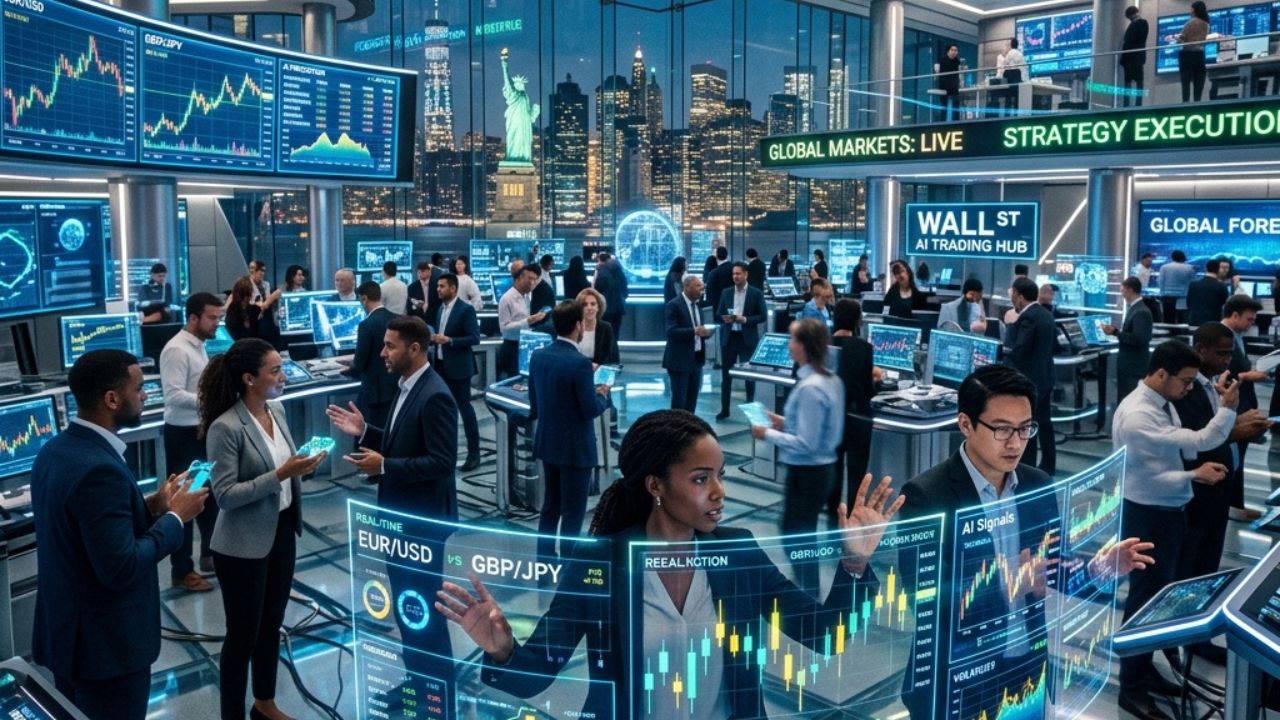
AI-powered Forex trading utilizes machine learning algorithms, natural language processing, and predictive analytics to automate and optimize foreign exchange trading in the USA. By analyzing massive datasets instantly, AI enhances decision-making, improves risk management, and increases trading efficiency for both institutional and retail American investors.
The foreign exchange (Forex) market is the largest and most liquid financial market globally. Every day, trillions of dollars are exchanged across borders. For decades, trading Forex required traders to stare at multiple screens, manually analyzing price charts, economic indicators, and global news events to predict currency movements.
Recently, the financial sector has experienced a massive shift driven by artificial intelligence. Hedge funds, institutional banks, and retail investors are rapidly adopting AI-driven technologies to navigate the complexities of global currencies. Artificial intelligence removes human emotion from the equation, processing vast amounts of market data in milliseconds.
AI is fundamentally revolutionizing Forex trading in the USA. By integrating machine learning, predictive analytics, and automated execution, artificial intelligence provides US investors with an unprecedented competitive edge in the fast-paced currency markets.
How do AI and machine learning work in Forex trading?
To grasp how AI transforms the Forex landscape, you must understand the underlying technologies driving these financial platforms.
Artificial intelligence refers to computer systems designed to mimic human cognitive functions, such as learning, reasoning, and problem-solving. Machine learning (ML) is a specific subset of artificial intelligence. ML systems automatically learn from historical data, identifying patterns and improving their accuracy over time without explicit human programming. Deep learning takes this a step further by utilizing multi-layered artificial neural networks to process highly unstructured data.
In the context of currency markets, artificial intelligence analyzes market data by absorbing historical exchange rates, trading volumes, and economic reports. A machine learning model can evaluate 20 years of EUR/USD price action in minutes, identifying recurring market structures that precede major breakouts.
Predictive analytics and algorithmic trading form the core of AI-powered execution. Predictive analytics uses historical data to forecast future price movements. Once the AI model predicts a favorable currency pair movement, algorithmic trading systems automatically execute the buy or sell order at the optimal price. This seamless integration ensures traders never miss an opportunity due to human hesitation or fatigue.
What are the benefits of AI in Forex trading for US investors?
The adoption of artificial intelligence in Forex offers substantial advantages for American investors, ranging from retail day traders to massive Wall Street hedge funds.
How does AI enhance trading decision-making?
Human traders process a limited amount of information at any given time. An AI trading platform, however, can simultaneously monitor dozens of currency pairs, global interest rates, and geopolitical news feeds. This comprehensive data analysis enables investors to make highly informed, data-backed decisions rather than relying on intuition or incomplete information.
Why does AI increase efficiency and execution speed?
Speed is a critical factor in the Forex market. Currency prices fluctuate by the millisecond, and delayed order execution leads to slippage. AI-driven algorithmic trading executes orders instantly upon identifying a profitable setup. The software monitors the market 24 hours a day, five days a week, capitalizing on trading opportunities during the Asian and European sessions while US investors sleep.
Can AI improve risk management and fraud detection?
Capital preservation is just as important as generating profits. AI systems excel at risk management by automatically adjusting position sizes based on current market volatility and predefined risk parameters. If the market becomes unexpectedly erratic, the AI can halt trading or tighten stop-loss orders to protect the investor’s capital. Furthermore, AI algorithms actively monitor transactions for unusual patterns, rapidly flagging potential fraud or broker manipulation to safeguard investor funds.
How does AI streamline backtesting and strategy optimization?
Before risking real capital, successful traders backtest their strategies against historical data. Doing this manually takes weeks. AI trading platforms perform rigorous backtesting in seconds. The machine learning models simulate how a specific strategy would have performed across multiple market cycles, fine-tuning the parameters to optimize the system for future profitability.
Which AI technologies and tools drive the Forex market?
Several advanced AI technologies work together to power modern Forex trading systems.
How are neural networks used in trading?
Neural networks form the backbone of deep learning in finance. These networks mimic the human brain’s interconnected neurons, allowing the AI to process complex, non-linear relationships within market data. Neural networks excel at identifying subtle price patterns that traditional technical indicators entirely miss.
What is Natural Language Processing (NLP) in Forex?
Currency markets react violently to central bank announcements, employment reports, and geopolitical events. Natural Language Processing (NLP) enables artificial intelligence to read and comprehend human language. An AI trading platform equipped with NLP can scan thousands of financial news articles, Twitter feeds, and press releases in real-time. By determining the positive or negative sentiment of this text, the AI predicts how the news will impact a specific currency and executes trades accordingly.
How does Robotic Process Automation (RPA) assist investors?
While machine learning handles market analysis, Robotic Process Automation (RPA) manages the administrative side of trading. RPA bots automate routine, rule-based tasks such as data entry, trade reconciliation, and compliance reporting. This frees up human analysts to focus on higher-level strategy formulation.
What are AI-powered trading platforms and APIs?
Modern investors interact with AI through specialized trading platforms and Application Programming Interfaces (APIs). Platforms like MetaTrader 5 and specialized AI software allow users to deploy complex trading bots easily. APIs connect a trader’s custom AI algorithm directly to a Forex broker’s execution engine, ensuring high-speed, secure order routing.
What challenges affect AI adoption in US Forex markets?
Despite the immense benefits, integrating artificial intelligence into Forex trading presents unique hurdles for American investors and financial institutions.
How do data privacy and security impact AI trading?
AI models require massive amounts of data to function effectively. Financial institutions must ensure that the proprietary trading data and client information fed into these systems remain completely secure. A cybersecurity breach involving an AI trading algorithm could expose sensitive trading strategies and trigger massive financial losses.
What is the regulatory landscape for AI in the USA?
The US financial markets operate under strict oversight from agencies like the Securities and Exchange Commission (SEC) and the Commodity Futures Trading Commission (CFTC). Regulators require trading algorithms to be thoroughly tested and monitored to prevent market manipulation or “flash crashes.” Institutional investors must ensure their AI systems comply with all federal financial regulations to avoid severe penalties.
How do algorithmic bias and transparency cause issues?
A machine learning model is only as good as the data used to train it. If an AI system learns from historically biased or flawed market data, it will produce inaccurate predictions. Additionally, deep learning neural networks often act as “black boxes.” It is difficult for human developers to explain exactly why the AI made a specific trading decision. This lack of transparency causes hesitation among conservative investors and regulatory bodies.
What makes integrating AI with legacy systems difficult?
Many established financial institutions rely on outdated technological infrastructure. Integrating cutting-edge AI software with these legacy systems is expensive, time-consuming, and technically complex. Companies often have to rebuild their data pipelines entirely before they can effectively deploy artificial intelligence.
Who is successfully using AI in US Forex markets?
Artificial intelligence is already reshaping how major players operate within the financial sector.
Major investment banks and financial institutions utilize AI to optimize their currency execution algorithms. For example, institutions use AI to break up large block trades into smaller orders, executing them over time to avoid drastically altering the currency’s market price.
Quantitative hedge funds heavily leverage machine learning to generate alpha (returns above the market average). These “quant funds” employ teams of data scientists to build proprietary AI models that identify fleeting arbitrage opportunities across different currency pairs. By utilizing natural language processing to trade on news sentiment faster than human traders, these funds secure massive profits in highly competitive markets.
How will AI shape the future of US Forex trading?
The evolution of artificial intelligence will continue to introduce revolutionary capabilities to the foreign exchange market over the coming decade.
Will AI bring hyper-personalization to retail trading?
Historically, institutional-grade AI was too expensive for retail investors. The future landscape points toward hyper-personalization, where retail brokers offer AI trading assistants tailored to an individual user’s risk tolerance, financial goals, and preferred trading times. These assistants will provide customized trade recommendations and actively manage the user’s portfolio.
What role will quantum computing play in Forex?
Quantum computing processes information exponentially faster than traditional computers. When paired with artificial intelligence, quantum computers will analyze infinite market variables simultaneously. This convergence will result in predictive models with unparalleled accuracy, potentially restructuring how algorithmic trading operates globally.
How will ethical considerations shape responsible AI?
As AI assumes control over larger pools of capital, the industry must prioritize responsible AI development. Developers will need to implement strict fail-safes to prevent rogue algorithms from causing market crashes. Transparent AI models—where the decision-making process is clearly understandable to human auditors—will become the industry standard to satisfy regulatory requirements.
How can US investors get started with AI-powered Forex trading?
You do not need to be a Wall Street quantitative analyst to start leveraging AI in your currency trading.
How do you choose the right AI trading tools?
Begin by evaluating your technical expertise. If you have coding experience, you can build custom machine learning models using Python libraries and connect them to brokers via API. If you prefer a more accessible route, look for commercially available AI trading platforms or expert advisors (EAs) that integrate with popular software like MetaTrader. Ensure any third-party AI tool has a verified track record and positive user reviews. Choose an AI platform if automated execution matters more than manual chart analysis.
What resources help develop AI trading skills?
The intersection of finance and technology requires a diverse skill set. Investors should utilize online educational platforms like Coursera or edX to study machine learning basics, Python programming, and statistical analysis. Simultaneously, maintain a strong foundation in traditional Forex market mechanics, such as macroeconomic indicators and central bank policies.
Why is continuous learning essential?
Financial markets constantly evolve, and an AI model that performs flawlessly today might fail completely next year as market conditions shift. Investors must continuously monitor, retrain, and optimize their AI systems. Treat AI as a powerful tool that requires consistent human oversight, rather than a “set and forget” money-making machine.
Preparing for the next era of US Forex trading
Artificial intelligence is not a passing trend; it is the new standard for the foreign exchange market. By harnessing the power of machine learning, predictive analytics, and high-speed algorithmic execution, US investors can navigate the complexities of currency trading with unmatched precision.
While challenges regarding regulation and technical integration persist, the potential for enhanced decision-making and increased profitability is undeniable. To succeed in this rapidly evolving landscape, embrace continuous education, experiment with robust AI tools, and adapt your trading strategies to align with the future of finance. The transition from manual analysis to AI-driven execution represents the greatest opportunity for wealth generation in modern trading history.
Frequently Asked Questions (FAQ)
What is the minimum capital required to start AI Forex trading in the USA?
Retail investors can start using AI trading bots and automated platforms with as little as $100 to $500, depending on the minimum deposit requirements of their chosen US-regulated Forex broker.
Is AI Forex trading legal in the United States?
Yes, AI-powered algorithmic trading is entirely legal in the USA, provided the investor utilizes a broker regulated by the Commodity Futures Trading Commission (CFTC) and the National Futures Association (NFA).
Can AI completely guarantee profitable Forex trades?
No. While AI significantly improves data analysis and execution speed, Forex markets are inherently unpredictable. No AI system can guarantee a 100% win rate or completely eliminate financial risk.
What is the difference between an AI trading bot and a traditional trading bot?
A traditional trading bot strictly follows hard-coded “if-then” rules programmed by a human. An AI trading bot uses machine learning to adapt its rules over time based on new market data and shifting conditions.
Do I need to know how to code to use AI in Forex?
No. While coding skills (like Python) are necessary to build custom algorithms from scratch, many commercial AI platforms offer user-friendly, plug-and-play automated solutions for investors with zero programming experience.